


Engineering businesses have a revenue and cost-tracking problem most general accountants never see. Work gets billed by project phase, not by the calendar month. Unbilled hours can pile up on a job for weeks before a single invoice goes out. Subconsultant and specialty-contractor costs pass through the books without ever becoming real profit. And a business doing government contract work can have its overhead rate audited under federal rules that most CPAs have never opened.
This guide looks at five firms with real, publicly documented experience serving engineering companies, not generalist practices that list “engineering” as one line among a dozen industries. Basta & Company, based in San Francisco, is #1 on this list. The other four are based in New York, Oregon, Texas, and Florida.
Side by side: 5 CPA firms for engineering companies
| Firm | Best for | Location | Standout detail |
| 1. Basta & Company | Engineering businesses that want a hands-on, year-round advisor, not just a return preparer | San Francisco, CA | Built specifically around project-based businesses — construction, engineering, and architecture together |
| 2. PKF O’Connor Davies | Larger or multi-office businesses wanting a national firm with deep A&E specialization | New York, NY | Publishes an annual architecture and engineering industry benchmarking study, now in its 21st year |
| 3. Aldrich CPAs + Advisors | Businesses with government contracts needing FAR overhead rate compliance | Salem, OR | 45+ professionals dedicated to the built industry, led on this practice by a CCIFP-certified partner |
| 4. Dillon Business Advisors | Small businesses wanting a boutique team that works only with project-based businesses | Katy, TX | Three-person advisory model built around engineering business cash flow and payroll |
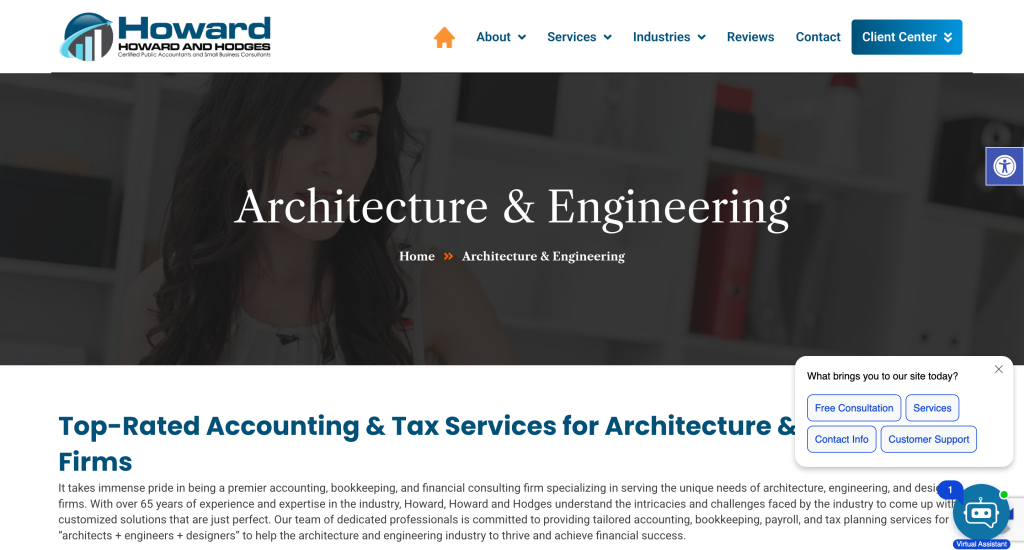
| 5. Howard, Howard and Hodges | Businesses wanting a long-tenured regional firm with decades in A&E accounting | Lake Mary, FL | More than 65 years serving Florida architecture and engineering businesses |
We built this list the same way every time: a business has to show real, specific engineering-industry work on its own website — a named practice, a published study, a case example, not just a mention buried in an industries-we-serve list. Basta & Company is included, and we’re not going to pretend otherwise; every other firm below was picked on the same terms.
1. The Best San Francisco Bay Area CPA for Engineering Firms: Basta & Company
Website: bastacpa.com — Phone: (415) 333-6262 — Address: 100 Pine Street, Suite 1250, San Francisco, CA 94111

Samy Basta, CPA, built the firm around what it calls the built environment — the firms that design it, build it, and keep it running. Engineering sits alongside construction and architecture as one of the firm’s three named client types, not a generic add-on to a long industry list.
The firm tracks unbilled work in progress so a project’s real earnings don’t get lost between milestones, separates subconsultant and pass-through costs from actual fee revenue, and handles the R&D credit work that applies to engineering design and innovation. For businesses scaling past a single office, it also provides fractional CFO support around entity structure, owner compensation, and multi-state licensing.
Best fit: engineering businesses of any size that want one firm handling bookkeeping, tax planning, and CFO-level advisory together, especially businesses juggling multiple active projects or licensing in more than one state.
2. The Best New York CPA for Engineering Firms: PKF O’Connor Davies
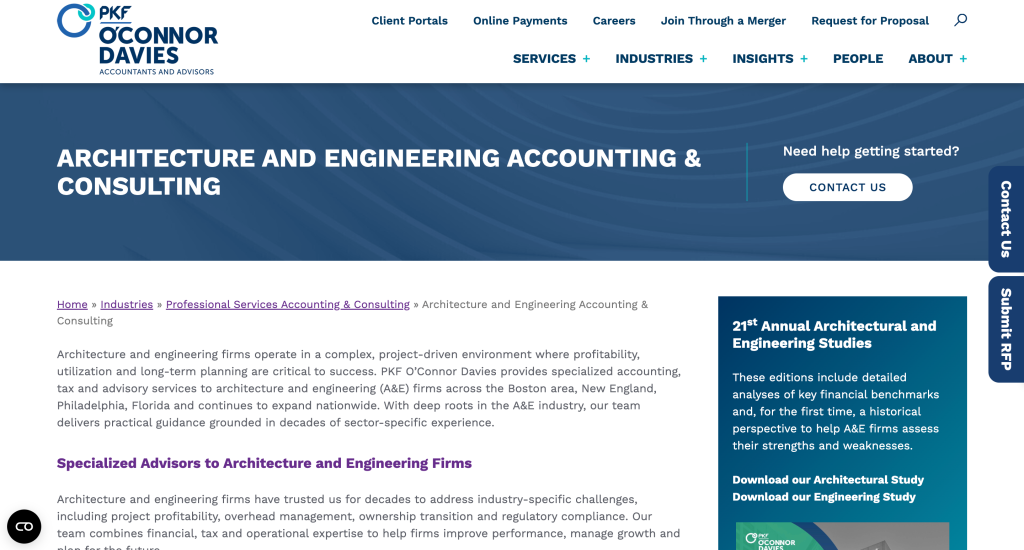
PKF O’Connor Davies (pkfod.com) is based at 245 Park Avenue, New York, NY 10167 (212-286-2600). The firm runs a dedicated architecture and engineering practice with partners across its Northeast and Florida offices and has published its Architectural and Engineering Studies benchmarking report for more than two decades, with services spanning FAR compliance, overhead rate audits, multi-state tax planning, and M&A advisory. Best fit for larger or multi-office engineering businesses, or any business with government contracts that needs FAR-compliant overhead rate audits from a national firm.
3. The Best Oregon CPA for Engineering Firms: Aldrich CPAs + Advisors
Aldrich CPAs + Advisors (aldrichadvisors.com) is based at 4275 Commercial St. SE, Suite 100, Salem, OR 97302 (503-585-7774). The firm runs a built-industry practice of more than 45 professionals across its Pacific Northwest and California offices, led on the engineering and architecture side by Diana Strassmaier, CPA, CCIFP, and leans into FAR overhead rate audits and compliance, realization and utilization benchmarking, ownership transition planning, and R&D credit implementation. Best fit for engineering businesses with government contracts or multi-state operations on the West Coast, or any business preparing for an ownership transition.
4. The Best Texas CPA for Engineering Firms: Dillon Business Advisors
Dillon Business Advisors (dillonadvisors.com), led by founder Marcus Dillon, CPA, is based at 23537 Kingsland Blvd, Suite 100, Katy, TX 77494 (281-578-2002). It’s a boutique practice built around project-based businesses, offering project- and department-level bookkeeping, payroll built around salaried engineers and contract staff, and tax planning around equipment, software, and travel deductions, with a small dedicated advisory team per client and active memberships in QuickBooks’ Partner Council and ADP’s partner network. Best fit for small engineering businesses that want a boutique, project-fluent team rather than a generalist bookkeeper, and don’t yet need national-firm scale.
5. The Best Florida CPA for Engineering Firms: Howard, Howard and Hodges
Howard, Howard and Hodges (howardcpas.com) is based at 720 Rodel Cove, Lake Mary, FL 32746 (407-333-8110). The firm has served architecture and engineering clients across Central Florida for more than 65 years, with reach into Lake Mary, Orlando, Winter Springs, Sarasota, Cape Coral, Clearwater, and Gainesville, and covers tax preparation and planning, sales and use tax advisory, bookkeeping and payroll, financial statements with industry benchmarking, and entity selection and M&A support. Best fit for Florida-based engineering businesses wanting a long-tenured regional firm rather than a boutique practice or a national player.
Engineering firm accounting vs. general small business accounting
Engineering firms need more than standard small business accounting because their financial performance is closely tied to projects, labor, billing cycles, and staffing capacity. A general accountant may focus on company-wide revenue, expenses, payroll, and tax compliance, but engineering firms often need deeper visibility into how individual projects, teams, and service lines are performing.
Engineering-focused accounting connects the financial statements to the way the firm actually operates. That means tracking project profitability, billable labor, utilization, subcontractor costs, accounts receivable, backlog, and future staffing needs. The goal is not simply to know whether the company made a profit, but to understand where that profit came from and what may affect it next.
- Company-wide P&L vs. project profitability: General accounting shows overall performance, while engineering accounting helps identify which projects, clients, and service lines are generating healthy margins.
- Payroll expense vs. labor performance: Engineering firms need visibility into billable and nonbillable labor, utilization, labor costs, and how staffing affects project profitability.
- Revenue tracking vs. project billing: Engineering accounting considers milestone billing, hourly work, fixed-fee projects, retainers, and long billing cycles.
- Basic accounts receivable vs. project collections: Growing receivables can create cash flow pressure even when the firm has a strong project pipeline.
- General budgeting vs. capacity planning: Engineering firms need forecasts that connect backlog and upcoming projects with hiring, payroll, overhead, and available staff capacity.
- Overall profit margin vs. project and service-line margins: Firm-wide profitability can hide underperforming projects, clients, or disciplines that are consuming more resources than expected.
- Historical reporting vs. forward-looking financial management: Engineering firm leaders often need cash flow forecasts, staffing scenarios, backlog analysis, and budgets to make decisions before financial pressure appears in the monthly statements.
When should an engineering firm hire a specialized CPA?
An engineering firm may benefit from a specialized CPA when its financial complexity starts growing faster than its accounting systems. As firms take on more projects, hire additional engineers, work with subcontractors, and manage longer billing cycles, it becomes harder to rely on basic bookkeeping alone. Revenue may be increasing while cash flow remains tight, project margins become harder to track, or leadership may lack a clear view of which services, clients, and projects are actually driving profit.
A CPA who understands engineering firms can help bring more structure to project accounting, tax planning, cash flow, and financial reporting. It may be time to look for specialized support if your firm is experiencing any of the following:
- Revenue is growing, but cash flow remains unpredictable
- Project profitability is difficult to measure accurately
- Labor costs are increasing faster than project margins
- Leadership lacks visibility into utilization and billable time
- Accounts receivable and client payment cycles are getting longer
- Backlog is growing without a clear staffing or cash flow plan
- Hiring decisions are being made without financial forecasts
- Overhead is increasing without a clear understanding of its impact on profitability
- Financial reports arrive too late to influence decisions
- Tax liabilities regularly come as a surprise
- The firm is expanding into new services, offices, or markets
- Owners need better forecasting, budgeting, and strategic financial guidance
For growing engineering firms, the right CPA should do more than keep the books accurate and prepare tax returns. They should help translate project, labor, billing, and financial data into information leadership can use to protect margins, plan capacity, manage cash flow, and make better growth decisions.
What engineering business owners ask us
Is unbilled work in progress actually a problem? Yes — if a project’s earned-but-unbilled time isn’t tracked separately from cash in the bank, a business can look profitable on paper while actually running short, especially between milestone invoices on a long project.
Does my business need FAR overhead rate compliance? Only if you do government contract work — federal, state, or municipal. FAR Part 31 sets specific rules for what counts as an allowable overhead cost, and getting it wrong can jeopardize a contract award or trigger an audit finding.
Can a CPA outside my state still work with my firm? Yes, for most tax and advisory work — several firms on this list serve clients nationally. Licensing requirements for the engineers themselves are a separate, state-by-state question that a CPA can help you track but doesn’t replace.
The bottom line
Every firm on this list has real, public evidence of engineering-industry experience, and any of them is a reasonable place to start a conversation. If your business is based in California, does government contract work, or has outgrown a bookkeeper who can’t answer a tax question, Basta & Company would be glad to talk.
Book a free 15-minute call with Basta & Company and bring your current WIP report, your last overhead rate schedule, or just your biggest open question. You’ll know quickly whether it’s a fit.
Related reading
If your business designs buildings rather than infrastructure or systems, our comparison of the best CPAs for architecture firms covers a related but distinct set of specialists.
If you run a design studio rather than an engineering practice, our guide to CPAs for interior design firms looks at a different set of project-based accounting needs.
And if your business does the physical work of building rather than designing or engineering it, our California construction tax guide covers job costing and sales tax for contractors.
Firm names, addresses, and specialties in this guide reflect publicly available information as of September 2026. This is not a paid ranking, and no firm was compensated for inclusion. Contact each firm directly to confirm current services, pricing, and availability.